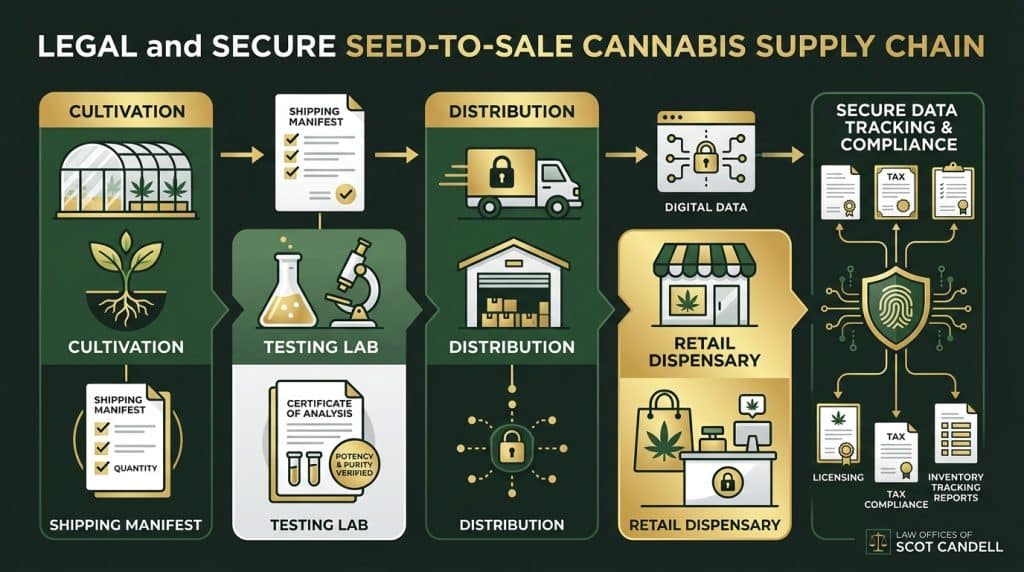
California cannabis licensees should treat the Department of Cannabis Control’s 2026 track-and-trace proposal as an important planning signal, not as a final statement of enforceable law. The proposal would introduce more defined controls around laboratory testing, shipping-manifest approvals, transaction data, tax reporting, and customer access to Certificates of Analysis. Because the public-comment period closed on July 20, 2026, businesses should monitor the final rulemaking record before making changes solely because of the proposal.
For cannabis businesses, the practical priority is to identify whether current standard operating procedures, technology configurations, contracts, and training programs could support the proposed framework if it is adopted. Early readiness can reduce disruption while preserving the distinction between prudent preparation and compliance with a rule that may still change.
What the Proposed Track-and-Trace Updates Address
The California Department of Cannabis Control’s proposed updates appear directed at improving the reliability, completeness, and accountability of information entered into the state’s track-and-trace system. Track-and-trace records affect far more than inventory management. They can be central to regulatory inspections, licensing compliance, product movement, testing documentation, tax reporting, and dispute resolution among commercial cannabis parties.
The proposal should be read carefully in its final form because the exact language, scope, effective date, and transition obligations may change before adoption. Still, the themes reflected in the proposal provide a useful basis for a cannabis compliance review now.
Proposed Safeguards Intended to Address Lab Shopping
One notable proposed area concerns safeguards intended to reduce laboratory shopping. In general terms, lab shopping can refer to attempts to seek a more favorable testing outcome by moving a product from one laboratory to another after an undesirable result or by otherwise using testing processes in a manner that undermines the integrity of the regulated market.
The proposed updates would place greater emphasis on traceable testing decisions and documentation. For cultivators, manufacturers, distributors, and testing laboratories, this means that sample handling, test results, retesting decisions, and transfers should be supported by accurate records and clearly assigned responsibilities. A sound procedure should document who authorized a testing-related action, why it was taken, and how the action was reflected in track-and-trace records.
These are proposed safeguards, not current obligations created by the proposal itself. Nevertheless, the Law Offices of Scot Candell recommends that California cannabis businesses assess whether their existing testing policies can show a consistent, good-faith compliance process.
Proposed Approval Requirements for Shipping Manifests
The proposed rules would require approval by all relevant parties before a shipping manifest is generated. If adopted as described, this would reinforce the need for coordinated controls among the sending licensee, receiving licensee, and any other party whose approval is required for the transaction.
Operationally, businesses should evaluate whether their systems prevent a manifest from being created before required approvals are documented. A workflow that relies on informal messages, shared passwords, or verbal confirmation may create avoidable uncertainty. Licensees may instead consider role-based approvals, time-stamped records, exception escalation procedures, and an auditable record of changes or cancellations.
For distributors in particular, manifest controls should align with pickup, transport, delivery, rejection, and return procedures. For all participants, the proposed change highlights the importance of ensuring that the commercial agreement, physical movement of goods, and track-and-trace record tell the same story.
More Precise Proposed Data-Entry Duties
The proposed updates would also impose more precise data-entry duties. Accurate information is a foundational component of California cannabis licensing and regulatory compliance. Incomplete, delayed, or inconsistent entries can complicate reconciliation, obscure custody history, and increase the risk of regulatory questions.
Licensees should begin by mapping each required business event to the person, department, or vendor responsible for entering and verifying the corresponding data. This includes production events, transfers, adjustments, waste, testing activity, sales, returns, and corrections. A second-person review for higher-risk entries can help identify errors before they become embedded in a chain of records.
Businesses should also define who may correct data, when a correction is permitted, what supporting documentation is required, and how the business retains an internal record of the correction. These controls support practical risk management whether or not the proposed language is adopted unchanged.
Proposed Retailer Tax Information Requirements
The proposal would require retailers to enter specified sales-tax and excise-tax information into the track-and-trace system. If finalized, this requirement could require closer coordination between retail operations, point-of-sale platforms, accounting systems, and compliance personnel.
Retailers should not assume that information captured in one system automatically satisfies another system’s requirements. A data map can identify the source of each tax-related field, the responsible owner, the timing of entry, the method for correcting discrepancies, and the records used to reconcile reported amounts. This is especially important when a retailer uses outside point-of-sale, inventory, accounting, or compliance vendors.
The Law Offices of Scot Candell encourages businesses to obtain tax advice appropriate to their facts and to coordinate that advice with their cannabis law and business law compliance processes. Proposed reporting requirements should be reviewed alongside existing state and local obligations rather than in isolation.
Proposed Certificate of Analysis Access for Customers
Another proposed update would require retailers to provide a Certificate of Analysis to a customer upon request. A Certificate of Analysis, often called a COA, generally communicates laboratory test information associated with a cannabis product. If the proposal is adopted, retailers will need a dependable process for identifying the applicable COA and providing it promptly while protecting the accuracy of product information.
A well-designed response procedure can specify where COAs are stored, how staff confirm the product and batch or lot information, which employees are authorized to respond, and how the retailer documents fulfillment. Electronic access may improve consistency, but the process should include contingency steps for system outages, product returns, or customer requests made after a purchase.
Why Licensees Should Audit SOPs Now
Auditing procedures now does not mean treating proposed provisions as currently enforceable. It means assessing readiness, locating control gaps, and building a practical implementation plan that can be adjusted when final regulations are issued.
This distinction matters. Prematurely changing procedures without confirming final rule language can create cost, confusion, and contract conflicts. Waiting until an effective date is known, however, may leave a licensee without enough time to train staff, revise vendor integrations, test system permissions, and update documentation. A measured readiness audit gives management the information needed to respond efficiently once the Department of Cannabis Control completes rulemaking.
Operational Readiness Checklist by License Type
The following checklist is designed as a planning tool for cannabis licensees. It does not replace a review of final regulations or advice tailored to a particular operation.
- Cultivators: Review user permissions for inventory and transfer entries; confirm lot and batch records can be reconciled to physical inventory; document testing and transfer authorization steps; and train staff on timely, accurate data entry.
- Manufacturers: Map material inputs, production events, waste, testing, packaging, and outgoing transfers to responsible users; establish approval controls before manifests are generated; and retain records supporting adjustments and corrections.
- Distributors: Implement clear transfer-approval workflows; prevent manifest creation until all required parties have approved; reconcile manifests to transport, delivery, return, and rejection records; and define escalation procedures for discrepancies.
- Testing Laboratories: Review sample receipt, chain-of-custody, testing, reporting, retesting, and result-correction procedures; restrict system access by role; and ensure records support transparent, consistent testing decisions.
- Retailers: Establish a COA response procedure for customer requests; map required sales-tax and excise-tax information from point-of-sale and accounting systems to track-and-trace entries; and perform regular reconciliations and exception reviews.
- All Licensees: Conduct periodic internal audits; maintain role-based user permissions; preserve approval and manifest records; provide documented staff training; and review vendor contracts for responsibility allocation, data accuracy, system access, audit cooperation, confidentiality, and remediation of errors.
Preparing for Final Rulemaking
The public-comment period for the proposed updates closed on July 20, 2026. That closure does not, by itself, establish that every proposed provision has been adopted or is enforceable. Before changing procedures, licensees should check the Department of Cannabis Control’s final rulemaking status, final regulatory text, effective dates, and any implementation guidance.
For businesses throughout California, the best approach is to maintain a documented readiness plan, monitor official developments, and revise policies when final requirements are confirmed. This approach supports sound cannabis compliance while avoiding the mistake of presenting a proposal as settled law.
FAQ
Are the 2026 DCC track-and-trace updates currently enforceable?
Not based solely on the proposal described here. Licensees should confirm whether final regulations have been adopted, the language that was adopted, and the applicable effective date before treating a proposed requirement as enforceable.
What is the proposed manifest approval change?
The proposal would require approval by all relevant parties before a shipping manifest is generated. Businesses should review final regulatory language to determine precisely which parties, approvals, and exceptions are covered.
How can a retailer prepare for the proposed COA requirement?
A retailer can organize COAs by product and batch or lot, assign trained personnel to respond to requests, establish verification steps, and maintain a record of responses. The retailer should confirm the final rule before implementing a process as a legal requirement.
Why should a cannabis business review vendor contracts?
Track-and-trace, point-of-sale, accounting, laboratory, and logistics vendors may handle critical data or system access. Contracts should clearly allocate responsibilities for data quality, user access, security, assistance during audits, corrections, and regulatory changes.
When should a licensee change its SOPs?
Licensees can audit and draft contingency updates now, but should check final DCC rulemaking status before implementing changes solely to meet a proposed requirement. Final text and effective dates should guide the operative SOP revision plan.
The Law Offices of Scot Candell assists California cannabis businesses with licensing, compliance planning, business law matters, and regulatory risk assessment. To discuss how proposed DCC changes may affect your operation, contact our San Rafael law firm for a consultation.
This article is provided for informational purposes only and does not constitute legal advice. Reading it does not create an attorney-client relationship. Regulatory requirements can change, and businesses should seek advice tailored to their specific facts and current law.